
The app store can offer a long list of answers before you have worked out the question. Do you want something quiet to hear at bedtime, a guided meditation, or a place to learn about recurring worries? This anxiety relief app guide compares Headspace, MindShift CBT, Calm, Insight Timer and UCLA Mindful by those everyday uses. Choosing a format is not the same as choosing treatment, and no app here is ranked by proven clinical superiority.
- Best anxiety relief apps 2026: choose Headspace for guided meditation, not as a replacement for counseling.
- MindShift CBT suits structured worry exercises; Calm suits bedtime relaxation.
- Insight Timer offers meditation variety; UCLA Mindful suits a simpler practice.
- New Beginnings offers in-office and telehealth counseling for people seeking emotional healing and personal growth.
An app is a tool, not someone who knows you
An anxiety app gives you something to practice between difficult moments. It does not understand your circumstances the way a conversation with a counselor can, and downloading one is not the same as receiving care.
New Beginnings is a counseling option for people seeking emotional healing and personal growth through in-office or telehealth sessions. If you want support beyond a self-guided exercise, explore New Beginnings.
Start with the job you need help doing: settling into bedtime, learning meditation, or responding differently to a recurring worry. That decision matters more than collecting features.
What makes the best anxiety relief apps?
For this 2026 guide, the strongest choice is the app whose approach matches your immediate goal. Use these criteria before comparing names:
- Clear purpose: You can explain what you will use the app for without listing its entire content library.
- Usable guidance: Instructions feel understandable when you are distracted or uneasy, not only when you feel settled.
- Repeatable practice: You can return to an exercise without spending the whole session searching.
- Appropriate boundaries: You understand that self-guided support is different from assessment, counseling, or emergency help.
- Comfort and privacy: You feel comfortable with the exercise and understand what information the app collects before entering sensitive details.
Privacy deserves its own check. The National Institute of Mental Health’s guidance on mental health technology highlights questions about privacy, effectiveness and overselling. Read the current policy, review permissions, and decide whether you want personal reflections stored in an app. Do not assume that a wellness app handles information in the same way as your counselor.
Best anxiety relief apps at a glance
Use this 2026 comparison to choose a starting point, not to predict which app will reduce your symptoms. The limitations below describe fit and scope rather than measured outcomes.
| App | Best for | Standout approach | Key limitation |
|---|---|---|---|
| Headspace | Learning guided meditation | Guided mindfulness practice | Meditation is not individualized counseling |
| MindShift CBT | Working through recurring worries | Exercises informed by cognitive behavioral therapy | Requires active reflection rather than listening alone |
| Calm | Building a bedtime relaxation routine | Meditation, sleep stories, and calming audio | Sleep-focused listening does not address every source of anxiety |
| Insight Timer | Exploring meditation styles | A broad selection of teachers and practices | More choice means more decisions before practicing |
| UCLA Mindful | Keeping meditation straightforward | Guided practices associated with UCLA | Less suited to someone seeking extensive entertainment-style content |
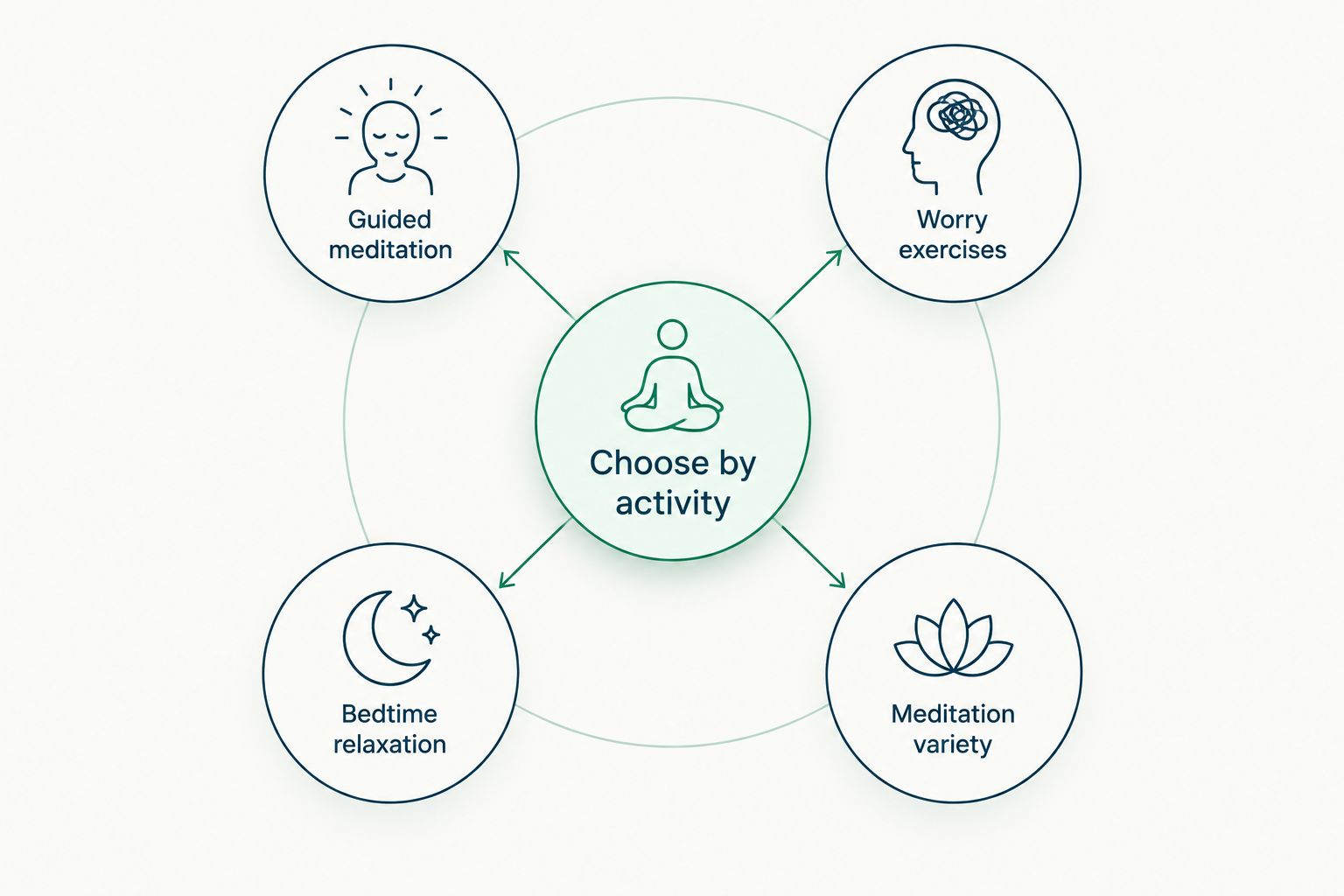
Choose by activity, not by reputation: listen with Headspace or Calm, work through worries with MindShift CBT, explore with Insight Timer, or simplify with UCLA Mindful.
1. Headspace: best anxiety relief app for meditation beginners
Headspace provides guided meditation and mindfulness content. Choose it when you want someone to explain the practice rather than being left alone with a timer and instructions to relax.
Best for: Learning guided meditation with spoken instruction. The useful distinction is guidance, not a promise that meditation will make difficult feelings disappear.
Headspace pros
- Guided instruction gives you a defined activity to follow.
- Mindfulness practice offers a way to notice thoughts without solving each one immediately.
- A repeatable meditation routine gives you an alternative to repeatedly searching for reassurance.
Headspace cons
- Self-guided meditation cannot explore your personal history or circumstances with you.
- Focusing inward can feel uncomfortable; you do not need to continue an exercise that increases distress.
Begin with a short guided practice and notice whether the instructions feel supportive. You are evaluating the experience, not trying to prove that you are good at meditation.
If your attention wanders, return to the instruction without treating that moment as a failure. If the exercise feels overwhelming, stop and consider a different kind of support.
Recommendation: Choose Headspace when learning meditation is your goal. Verdict: Hold if you want personalized help rather than guided practice.
2. MindShift CBT: best anxiety relief app for recurring worries
MindShift CBT, from Anxiety Canada, uses a cognitive behavioral therapy approach to anxiety self-management. Its emphasis on working with thoughts and behaviors makes it a different choice from an app centered on soothing audio.
Best for: People who want structured worry exercises. Choose this direction when you want to examine a concern rather than simply shift your attention away from it.
MindShift CBT pros
- A structured approach gives reflection a clearer purpose than repeatedly replaying a worry.
- Exercises connect thinking with actions rather than treating relaxation as the only goal.
- The format suits someone who prefers participating actively to listening passively.
MindShift CBT cons
- Reflective exercises require attention and effort when you might want something simpler.
- An app cannot adapt its questions with the judgment and context of a counselor.
The app’s written exercises are different from soothing audio. A therapist can help you decide whether that format is appropriate for what you are experiencing; this guide does not teach you to perform cognitive behavioral therapy on yourself.
Understanding a tool is enough for now. You do not need to complete an exercise or find a positive answer before you can ask someone for help.
Recommendation: Choose MindShift CBT for active reflection on recurring worries. Verdict: Skip when you want an audio-only relaxation experience.
3. Calm: best anxiety relief app for bedtime relaxation
Calm includes guided meditation, sleep stories, and calming audio. Its bedtime content makes it a relevant option when you want a deliberate transition away from the activity of the day.
Best for: Building a bedtime relaxation routine. Treat the app as a cue to wind down, not as a test you must pass by falling asleep immediately.
Calm pros
- Sleep stories offer something to listen to beyond your own stream of thoughts.
- Meditation and calming audio support different preferences within a bedtime routine.
- A familiar listening choice removes the need to decide what to do each evening.
Calm cons
- Bedtime listening does not resolve the circumstances behind persistent worry.
- Using your phone for relaxation creates an opportunity to return to messages or browsing.
Choose your audio before settling down. Then keep the rest of the routine simple instead of comparing tracks while watching the clock.
If sleep difficulties persist or affect your daytime functioning, speak with a healthcare professional. An app cannot determine what is causing the problem or whether another kind of care is needed.
Recommendation: Choose Calm for bedtime listening and relaxation. Verdict: Hold if you need help understanding persistent sleep difficulties.
4. Insight Timer: best anxiety relief app for meditation variety
Insight Timer offers guided meditations from different teachers alongside a meditation timer. It suits you when a teacher's voice, style, or approach strongly influences whether you want to continue practicing.
Best for: Exploring meditation styles before settling into a routine. Variety is the reason to choose it, but variety also needs a boundary.
Insight Timer pros
- Different teachers let you explore more than one style of guidance.
- Guided practices and a timer support different preferences for instruction.
- You can build a personal routine around the practices you find comfortable.
Insight Timer cons
- A large selection adds browsing decisions when you want a straightforward next step.
- Different teachers use different language and approaches, so not every practice will suit you.
Choose a practice based on your goal, then give yourself permission to stop searching. Afterward, write 1 sentence about whether the voice, pace, and instructions worked for you.
You do not need the most popular recording. You need one you understand and feel comfortable returning to without turning the selection process into another task.
Recommendation: Choose Insight Timer when exploring styles helps you find a fit. Verdict: Skip if browsing makes starting harder.
5. UCLA Mindful: best anxiety relief app for a simpler routine
UCLA Mindful offers guided mindfulness practices associated with UCLA. It is a useful starting point when you want to focus on learning a practice rather than exploring a large entertainment-style library.
Best for: Keeping meditation straightforward. The appeal is a clear practice to return to, not a promise of personalized anxiety care.
UCLA Mindful pros
- Guided practices give you spoken instructions rather than an unexplained period of silence.
- A practice-centered approach suits readers who do not want bedtime storytelling.
- Returning to a familiar exercise lets you focus on practicing rather than comparing options.
UCLA Mindful cons
- It is not individualized counseling or an assessment of your needs.
- A narrower purpose will not suit someone seeking extensive audio variety.
Choose an exercise whose instructions feel clear. Repeat it before deciding you need another app; familiarity gives you a chance to evaluate the practice itself rather than the novelty of downloading something.
Recommendation: Choose UCLA Mindful for straightforward guided practice. Verdict: Skip if extensive content variety is your main requirement.
How these apps were ranked
This 2026 ranking compares purpose, guidance, repeatability, and the limits of self-guided support. Headspace is the default recommendation for learning meditation; the other apps earn distinct places because they serve different needs.
The ranking is not a clinical comparison, a hands-on testing claim, or evidence that one app treats anxiety better than another. App features and privacy terms change, so check the current listing and policy before making a decision.
Which anxiety relief app should you choose?
Choose Headspace if you are undecided and want guided meditation. Choose MindShift CBT instead if your main goal is working through recurring worries rather than listening to a meditation.
For a manageable 2026 starting plan, follow these steps:
- Name the goal. Decide whether you want guided meditation, worry exercises, bedtime relaxation, or meditation variety.
- Try one practice. Start with 5 minutes if that feels manageable; this is a suggested starting point, not a treatment dose.
- Review the fit. After 7 days, ask whether the practice feels useful, manageable, and worth continuing. This is a personal check-in, not a deadline for improvement.
Stop an exercise that increases distress. You do not owe an app continued use, and you do not need to try every option before asking for support.
New Beginnings offers in-office and telehealth counseling for people seeking emotional healing and personal growth. Counseling gives you space to discuss what you are experiencing rather than relying only on a self-guided routine.
Explore counseling support
Learn about in-office and telehealth counseling for emotional healing and personal growth.
FAQ
What's the best anxiety relief app in 2026?
Headspace is this guide's default choice for learning guided meditation in 2026. Choose MindShift CBT instead when you want structured worry exercises; the recommendation reflects fit, not proven clinical superiority.
Is Calm better than Headspace for anxiety?
Calm is the clearer choice here for bedtime relaxation, while Headspace is the default for learning guided meditation. Neither recommendation means one app treats anxiety more effectively than the other.
What app should I use for recurring worries?
MindShift CBT is the most directly matched option in this list for structured work on recurring worries. Its approach requires active reflection rather than listening alone.
Can an anxiety app replace counseling?
An anxiety app does not replace individualized counseling. New Beginnings offers in-office and telehealth counseling for people seeking emotional healing and personal growth.
What if meditation makes me feel more anxious?
Stop the exercise if it increases distress. You can choose a different activity and talk with a qualified healthcare professional about support that fits your experience.
How long should I try an anxiety app?
Use a short personal check-in period rather than expecting improvement on a fixed schedule. Review whether the activity feels manageable and useful, and seek support sooner if distress is worsening or disrupting daily life.
What should I check before entering personal information?
Read the app's current privacy policy and review its permissions before entering sensitive information. Check how information is collected, used, shared, and deleted rather than assuming it receives the same protections as counseling records.
You do not have to try everything first
You do not have to become better at using an app before you deserve support. If tracking, searching, or maintaining a routine becomes another source of pressure, step back and ask what kind of help you actually need. Request a consultation with New Beginnings if you would like a conversation about support beyond an app.
If you are in emotional crisis in the United States, call or text 988 for the Suicide & Crisis Lifeline. If there is immediate danger or a medical emergency, call 911; a meditation or anxiety app is not emergency care.