
A book can put words to an experience you have struggled to explain. It can also ask more of you than you feel ready to give. Among the books on healing from trauma considered here, Judith Herman’s Trauma and Recovery offers a framework for understanding recovery, while What Happened to You? takes a conversational approach. Choose by the question you want to explore, not by a promise of quick healing.
- Trauma and Recovery leads this best books on healing from trauma list for its clear framework for recovery.
- What Happened to You? suits readers who prefer conversation to a textbook-style explanation.
- Complex PTSD: From Surviving to Thriving focuses on patterns connected to prolonged childhood trauma.
- Choose a book you can read without pushing past your limits; reading does not replace individualized care.
Why this matters
A trauma book can give you language for experiences that have been difficult to explain. It cannot assess your circumstances, respond when a passage becomes overwhelming, or tell you exactly what your healing should look like. The National Institute of Mental Health’s psychotherapy overview explains how professional care is tailored to a person’s needs. Reading about a treatment and receiving it are different experiences.
A useful trauma reading list in 2026 separates education from treatment. You deserve both understandable information and permission to stop reading when you have had enough.
If you want support beyond a book, New Beginnings offers in-office and telehealth counseling for individuals seeking emotional healing and personal growth. You do not need to finish a reading list before asking for help.
What makes the best trauma books in 2026
Use these criteria to decide whether a recommendation fits your needs:
- A clear purpose: The book explains trauma, offers reflection, or addresses a particular experience rather than promising everything.
- An understandable format: Conversations, clinical explanations, and practical exercises suit different readers.
- Respect for your pace: You can pause, skip examples, or leave exercises unfinished.
- Clear boundaries: Personal stories and an author's framework are not an individualized assessment.
- An honest limitation: No book covers every experience or replaces a relationship with a qualified professional.
The best starting book is the one that answers your question without asking you to push through distress. A respected title is not automatically the right first read for you.
Best trauma recovery books at a glance
| Book | Best for | Standout feature | Key limitation |
|---|---|---|---|
| Trauma and Recovery | Understanding the recovery process | Connects personal experiences with social context | Dense passages and accounts of violence |
| What Happened to You? | A conversational introduction | Discussion between Bruce D. Perry and Oprah Winfrey | Personal stories can still be difficult to read |
| Complex PTSD: From Surviving to Thriving | Exploring prolonged childhood trauma | Language for emotional flashbacks and self-criticism | A specific framework, not an individual assessment |
| The Body Keeps the Score | A broad mind-and-body overview | Brings research, clinical stories, and treatment discussions together | Extensive detail and distressing case material |
| Waking the Tiger | Exploring body awareness | Explains Peter A. Levine's body-oriented approach | Guided care and reading are not interchangeable |
| Trauma Stewardship | Caregivers and helping professionals | Focuses on the effects of supporting others | Not primarily a guide to processing personal trauma |
1. Trauma and Recovery: best for understanding the recovery process
Judith Herman's Trauma and Recovery places trauma within relationships, communities, and wider systems. It describes recovery through 3 stages: establishing safety, remembrance and mourning, and reconnection.
That structure gives you something more useful than a demand to move on. It makes room for the conditions around healing, including safety and connection, rather than treating recovery as willpower alone.
Trauma and Recovery pros:
- Provides a clear framework for thinking about recovery.
- Connects individual suffering with social circumstances.
- Gives substantial attention to safety and relationships.
Trauma and Recovery cons:
- Its detailed explanations require sustained attention.
- Accounts of abuse and violence can be upsetting.
Best for: Readers who want an organized explanation of trauma and recovery before choosing a more narrowly focused book.
Do not use its stages as deadlines. You can recognize something useful in the framework without deciding where you belong or measuring yourself against an expected sequence.
Verdict: Buy if you want a foundational explanation and feel ready for demanding material.
2. What Happened to You?: best for a conversational introduction
What Happened to You? pairs Bruce D. Perry's explanations with Oprah Winfrey's questions and personal reflections. It invites readers to ask about a person’s experiences instead of judging their behavior. That change in perspective offers a compassionate entry point.
The conversation format makes this a different reading experience from an academic account. You can follow an exchange rather than work through a sustained clinical argument.
What Happened to You? pros:
- Uses dialogue to introduce complex ideas.
- Connects explanations with recognizable human experiences.
- Encourages curiosity instead of blame.
What Happened to You? cons:
- Stories involving adversity can be emotionally demanding.
- It is not a structured workbook or personal treatment plan.
Best for: Readers who want an approachable introduction and prefer questions, stories, and discussion to dense exposition.
Approachable does not mean emotionally light. Give yourself permission to skip a story even when you understand why the authors included it.
Verdict: Buy if a conversational format makes difficult subjects easier for you to approach.
3. Complex PTSD: best for exploring prolonged childhood trauma
Pete Walker's Complex PTSD: From Surviving to Thriving discusses patterns associated with prolonged trauma, particularly difficult childhood experiences. Its recurring subjects include emotional flashbacks, the inner critic, and responses developed around danger.
The book supplies vocabulary for experiences that can otherwise feel disconnected. Treat recognition as a starting point for reflection, not proof of a diagnosis.
Complex PTSD pros:
- Focuses closely on the effects of prolonged childhood trauma.
- Gives substantial attention to shame and self-criticism.
- Includes practical suggestions alongside explanation.
Complex PTSD cons:
- Its focus will not match every reader's history.
- Familiar descriptions can encourage self-labeling without enough context.
Best for: Readers exploring how repeated childhood experiences connect with present-day emotions and relationships.
You do not have to adopt every label to benefit from a passage. Keep what helps you describe your experience, and bring confusing or upsetting material into a conversation with a qualified professional.
Verdict: Buy if prolonged childhood trauma is your main reading focus; skip it as a universal guide.
4. The Body Keeps the Score: best for a broad mind-and-body overview
Bessel van der Kolk's The Body Keeps the Score discusses trauma through research, clinical accounts, and approaches to treatment. Its scope includes connections among memory, bodily responses, emotions, and relationships.
This is a substantial overview, not a gentle exercise book. Choose it because you want detail, not because its prominence makes it feel like required reading.
The Body Keeps the Score pros:
- Brings several aspects of trauma into the same discussion.
- Explains why bodily experiences belong in conversations about trauma.
- Introduces multiple treatment approaches for further discussion.
The Body Keeps the Score cons:
- Case histories include disturbing material.
- Treatment descriptions do not establish what is appropriate for you.
Best for: Readers who want a detailed overview and feel comfortable with clinical stories and research discussion.
Read treatment chapters as education rather than instructions to assemble your own care plan. A description of an approach cannot account for your history, current needs, or preferences.
Verdict: Hold if detailed case material feels overwhelming; buy when breadth is your priority.
5. Waking the Tiger: best for exploring body awareness
Peter A. Levine's Waking the Tiger, written with Ann Frederick, presents a body-oriented understanding of trauma. It draws on observations of animals' responses to threat to explain Levine's approach to human experience.
The book shifts attention toward physical sensations and responses rather than relying only on a verbal account of events. That makes it a distinct option, not a replacement for the broader books above.
Waking the Tiger pros:
- Gives bodily experience a central place in the discussion.
- Offers a different perspective from primarily narrative accounts.
- Introduces concepts associated with Levine's approach.
Waking the Tiger cons:
- It presents a particular model rather than every perspective on trauma.
- Body-focused exercises are not equally comfortable for every reader.
Best for: Readers curious about body-oriented approaches who want to understand the ideas before discussing them with a professional.
You do not need to intensify a sensation, recover a memory, or complete an exercise to read successfully. Stop an activity that leaves you feeling more distressed or disconnected.
Verdict: Buy for an introduction to Levine's perspective; hold on exercises that feel unsettling.
6. Trauma Stewardship: best for caregivers and helping professionals
Laura van Dernoot Lipsky's Trauma Stewardship, written with Connie Burk, addresses the effects of exposure to other people's suffering. Its audience includes people whose work or caring roles bring them into repeated contact with distress.
This changes the question from how to process your own traumatic experience to how helping others affects your life. Those questions can overlap, but they are not interchangeable.
Trauma Stewardship pros:
- Centers the experience of people supporting others.
- Connects caring responsibilities with personal awareness.
- Gives attention to sustaining involvement without ignoring its effects.
Trauma Stewardship cons:
- It is not primarily a personal trauma recovery workbook.
- Individual reflection cannot resolve every workplace or caregiving problem.
Best for: Helping professionals, caregivers, and others who want to reflect on how witnessing suffering affects them.
Use the book to notice your needs, not to assign yourself more responsibility for difficult working conditions. Support for the helper belongs in the conversation too.
Verdict: Buy if supporting others is the main reason you are seeking a trauma book.
How to choose your starting point
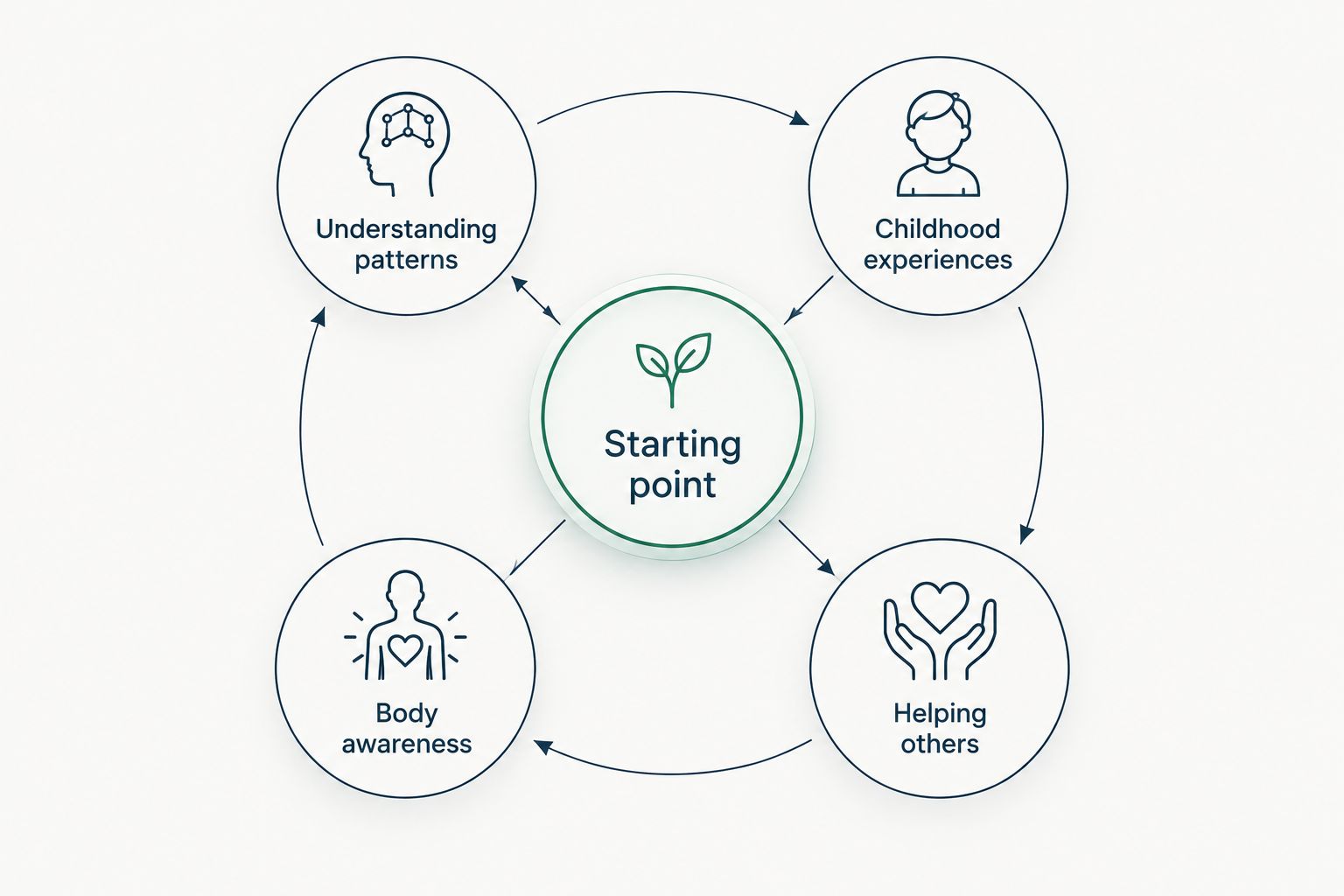
Begin with the question you want a book to answer. These reading goals point toward different choices:
- Understanding patterns: Choose Trauma and Recovery for its recovery framework or What Happened to You? for conversation-led explanation.
- Childhood experiences: Choose Complex PTSD when prolonged childhood trauma is your specific focus.
- Body awareness: Compare the broad overview in The Body Keeps the Score with Levine's particular perspective in Waking the Tiger.
- Helping others: Choose Trauma Stewardship when your concern centers on caregiving or helping work.
Your starting point does not commit you to finishing a book. Read the contents and opening pages before deciding whether its tone and level of detail fit what you need.
How to read without making it another obligation
Choose 1 book, not a recovery syllabus. You do not need competing explanations open at the same time, and you do not owe any author a finished book.
Before reading, identify 1 question you want help understanding. Afterward, you can note what felt useful, or decide that you do not want to reflect further that day. These are optional reading boundaries, not a treatment schedule.
Watch your experience rather than your page count. If reading leaves you distressed, stop and turn toward support or an ordinary activity that helps you feel settled.
New Beginnings offers in-office and telehealth counseling for emotional healing and personal growth. A book can give you a conversation starter; it does not have to become the plan for that conversation.
Why these books made the list
This 2026 ranking prioritizes purpose, format, scope, and limitations. Trauma and Recovery leads for its organizing framework; the remaining books occupy different reading roles rather than competing to explain every person's experience.
These recommendations are reading guidance, not a clinical assessment or a claim that one book produces better treatment outcomes.
Which trauma recovery book should you choose?
Choose Trauma and Recovery for a foundational explanation, or What Happened to You? if conversation is your preferred entry point. Choose the more focused titles only when their subject matches your question.
For your 2026 reading list, a manageable starting point matters more than completing every recognized title. Set aside any book that asks more of you than you want to give it right now.
What readers often ask
What's the best book on healing from trauma for a beginner?
What Happened to You? is the conversational starting choice on this list. Bruce D. Perry and Oprah Winfrey use discussion and stories, although some accounts remain emotionally difficult.
Is The Body Keeps the Score better than Trauma and Recovery?
The books suit different reading goals. The Body Keeps the Score offers a broad mind-and-body discussion, while Trauma and Recovery provides an organizing framework centered on safety, remembrance and mourning, and reconnection.
What's a useful book about healing from childhood trauma?
Pete Walker's Complex PTSD: From Surviving to Thriving is the focused childhood-trauma choice on this list. Use its descriptions for reflection rather than treating a sense of recognition as a diagnosis.
Can reading trauma books replace therapy?
No, a book cannot provide an individualized assessment or respond to your needs during a difficult moment. Reading can support understanding, but it is different from care tailored to you.
What should I do if a trauma book makes me feel worse?
Stop reading and give yourself permission to leave the material unfinished. If distress continues or feels difficult to manage, contact a qualified mental health professional for support.
Which trauma book is best for someone who helps other people?
Trauma Stewardship is the caregiver-focused recommendation on this list. Laura van Dernoot Lipsky and Connie Burk address how exposure to other people's suffering affects those who support them.
Does New Beginnings offer telehealth counseling?
New Beginnings offers both telehealth and in-office counseling sessions. Its services support individuals seeking emotional healing and personal growth.
You can leave a good book unfinished
A book can be valuable and still be wrong for you right now. Put a bookmark beside one useful passage rather than treating the final page as the goal. If you want support beyond reading, request a consultation with New Beginnings to explore counseling that fits your needs. You are reading to support yourself, not to prove how much difficult material you can tolerate.